
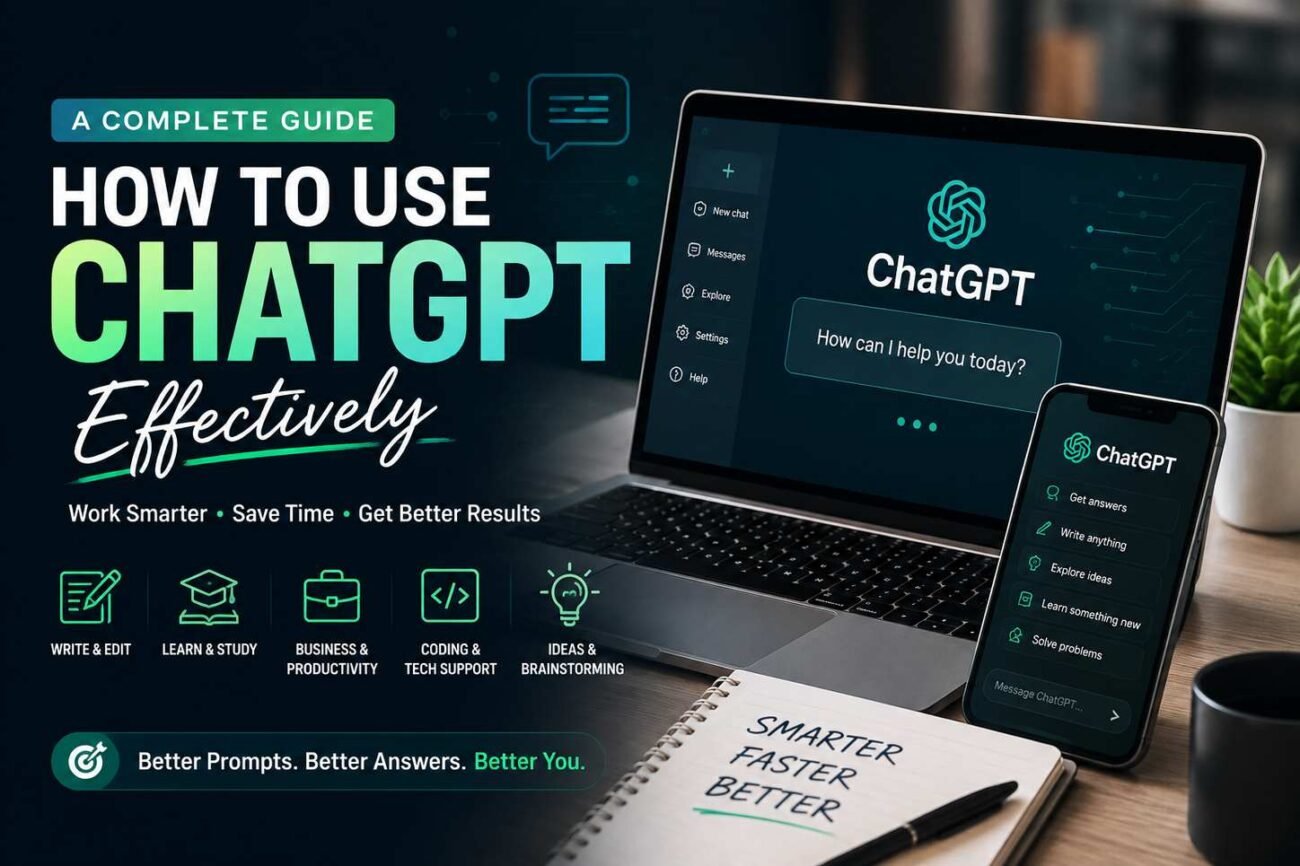
The use of ChatGPT has quickly become part of everyday digital life in the United States. Students use it to understand difficult topics, professionals use it to organize information, business owners use it to create ideas, and everyday users turn to it for writing, planning, research, and problem-solving.
But getting useful results from Chat GPT is about more than simply typing a question into a chat box. The quality of the response often depends on how clearly you explain what you need, what context you provide, and how you evaluate the information you receive.
Whether you are completely new to AI or already use Chat GPT regularly, understanding the right ways to use it can help you save time while getting more practical results.
Click here to read more about techbusinesspoint.
What Is ChatGPT?
Chat GPT is an AI assistant designed to understand natural-language conversations and generate responses based on the instructions and context provided by the user. It can help with many different tasks, including writing, brainstorming, explaining concepts, summarizing information, planning projects, analyzing text, and developing ideas.
One reason ChatGPT has become so popular is its conversational interface. Instead of learning complicated software commands, users can describe what they want in ordinary language and continue the conversation to improve the result.
However, Chat GPT should be treated as an assistant rather than an unquestionable source of truth. Important facts, professional decisions, current information, and sensitive topics should be verified using reliable sources.
Common Uses of ChatGPT
The use of Chat GPT extends across education, business, technology, communication, and personal productivity. Its usefulness depends largely on the user’s goal and instructions.
1. Writing and Editing
Cha tGPT can assist with many types of writing. Users can ask it to create an outline, improve clarity, rewrite a paragraph, generate ideas, or adjust the tone of existing content.
For example, a professional could use ChatGPT to create a first draft of an email and then edit the final version personally. A blogger might use it to brainstorm article topics or organize a complicated subject into a logical structure.
The best results usually come when users provide specific instructions instead of asking for something vague.
2. Learning and Studying
Students can use ChatGPT as a learning assistant. It can explain difficult concepts in simpler language, create practice questions, provide examples, or help learners understand where they made a mistake.
For instance, instead of asking, “Explain economics,” a student could ask:
“Explain inflation to a high school student using three simple real-world examples.”
A specific prompt gives the AI more useful context and makes the answer easier to understand.
Students should still complete their own assignments and verify important academic information. ChatGPT is most valuable when it supports learning rather than replacing it.
3. Business and Productivity
Small businesses and large organizations can use Chat GPT to improve everyday workflows. Common applications include brainstorming marketing ideas, preparing meeting agendas, drafting customer-service responses, organizing notes, creating checklists, and summarizing provided documents.
Entrepreneurs can also use AI to explore potential business ideas, identify questions customers may have, or develop initial content strategies.
The goal should not be to automate every business decision. Instead, ChatGPT can handle repetitive or time-consuming parts of a workflow while people remain responsible for judgment and final decisions.
4. Coding and Technical Support
Developers can use ChatGPT to understand programming concepts, review code, explain error messages, generate examples, and brainstorm possible solutions.
A beginner might ask for a simple explanation of an unfamiliar programming function. An experienced developer might use the tool to explore alternative approaches to a technical problem.
AI-generated code should always be reviewed and tested before being used in production. A response that looks correct can still contain security problems, incorrect assumptions, or bugs.
5. Brainstorming and Creativity
Another practical use of ChatGPT is idea generation. Writers, marketers, designers, entrepreneurs, and creators can use it when they need multiple possibilities quickly.
For example, a content creator could ask Chat GPT for 20 article ideas around a particular topic and then select the most useful ones for further research.
The AI does not have to produce the final creative work. It can act as a brainstorming partner that helps overcome the blank-page problem.
How to Use ChatGPT Effectively
Getting better results usually starts with better prompts. A prompt is the instruction or question you give to Chat GPT.
Be Specific
Instead of writing:
“Write about AI.”
Try:
“Write a beginner-friendly explanation of how generative AI is being used by small businesses in the United States.”
The second instruction establishes the topic, audience, and context.
Provide Context
ChatGPT can produce more relevant answers when it knows why you need the information.
For example, tell it whether the content is intended for a website, presentation, school project, business email, social media post, or personal research.
Define the Desired Format
You can also specify how you want the response structured. Ask for bullet points, a table, a step-by-step explanation, an outline, FAQs, or a short summary.
This can make the result easier to use without requiring extensive editing.
Ask Follow-Up Questions
One of the biggest advantages of ChatGPT is that you can continue the conversation. If the first response is too complicated, ask it to simplify the explanation. If something is missing, request additional examples or clarification.
This makes the interaction more useful than treating every prompt as a one-time search.
Benefits of Using ChatGPT
The growing use of Chat GPT is largely connected to its ability to help people work more efficiently.
Time savings: Chat GPT can help with repetitive writing, brainstorming, summarization, and organization.
Accessibility: Users can communicate with the system using ordinary language rather than specialized commands.
Learning support: Complex concepts can be explained at different levels depending on the user’s needs.
Idea generation: AI can quickly provide multiple starting points for projects and creative work.
Productivity: ChatGPT can help organize information and create structured plans.
However, these benefits are strongest when users combine AI assistance with their own knowledge, judgment, and verification.
What Should You Not Rely on ChatGPT For?
Understanding the limitations of AI is just as important as understanding its benefits.
ChatGPT can sometimes generate inaccurate information or present an incorrect answer confidently. For that reason, users should independently verify important claims.
Be especially careful with medical, legal, financial, security, and other high-stakes information. Professional advice may be necessary depending on the situation.
Users should also avoid sharing confidential business information, passwords, financial credentials, private customer data, or other sensitive information unless they fully understand the privacy and data-handling implications of the service they are using.
Is ChatGPT Useful for Businesses in the USA?
Yes, Chat GPT can be useful for businesses across the United States, particularly for tasks involving communication, research assistance, brainstorming, documentation, and productivity.
A local service company could use it to brainstorm frequently asked customer questions. A startup could use it to organize an initial product plan. A marketing team could use it to generate content ideas and draft variations for campaigns.
However, businesses should establish clear internal rules for AI use. Employees should know what information can be entered into AI tools, which outputs require human review, and which tasks should remain under professional supervision.
ChatGPT and Search Engines: What’s the Difference?
Traditional search engines are primarily designed to help users discover information across websites and other online sources. Chat GPT, by contrast, is designed around conversational interaction and generating responses.
These approaches can complement each other.
For current events, rapidly changing information, product availability, official policies, or other time-sensitive subjects, users should check current and authoritative sources. ChatGPT can then help explain, organize, or summarize information that the user provides.
This combination can make research more efficient while reducing the risk of relying on an outdated or unsupported answer.
Frequently Asked Questions
What is the main use of ChatGPT?
The main use of ChatGPT is to assist users with language-based tasks such as answering questions, explaining concepts, writing, brainstorming, summarizing, planning, and problem-solving.
Can I use ChatGPT for work?
Yes. Chat GPT can assist with many workplace tasks, including drafting emails, organizing information, brainstorming ideas, creating outlines, summarizing text, and supporting research.
Can students use ChatGPT?
Students can use Chat GPT as a learning aid for explanations, examples, practice questions, and brainstorming. They should follow their school’s academic policies and verify information before relying on it.
Is everything ChatGPT says accurate?
No. ChatGPT can make mistakes. Important information should be checked against reliable and authoritative sources, particularly when the consequences of an incorrect answer are significant.
How can I get better answers from ChatGPT?
Give clear instructions, provide relevant context, specify your audience and desired format, and use follow-up questions to refine the response.
Final Thoughts
The use of ChatGPT is no longer limited to technology professionals. From students and freelancers to entrepreneurs and corporate teams, people across the United States are using AI to support everyday tasks.
The most effective approach is not to treat ChatGPT as a replacement for human expertise. Instead, think of it as a flexible digital assistant that can help you generate ideas, organize information, learn faster, and complete routine tasks more efficiently.
When you combine clear prompts with human judgment, fact-checking, privacy awareness, and careful editing, ChatGPT can become a practical tool for both personal productivity and professional work.

One thought on “Use of ChatGPT: A Practical Guide to Using AI for Work, Learning, and Everyday Tasks 2026”