
Best Concepts of Digital Marketing: A Complete Guide to Online Growth
Digital marketing has become one of the most effective ways for businesses to reach customers, build trust, and generate sales. Whether you run a small local business, an e-commerce store, a startup, or an established company, understanding the concepts of digital marketing is essential for building a successful online presence.
Unlike traditional advertising, digital marketing allows businesses to connect with specific audiences, measure performance, and improve campaigns using real data. Moreover, channels such as search engines, social media, email, and content marketing help companies reach potential customers at different stages of their buying journey.
This guide explains the essential concepts of digital marketing in simple terms. Additionally, it explores how businesses in the United States can use these strategies to improve online visibility, attract qualified leads, and achieve sustainable growth.
What Are the Main Concepts of Digital Marketing?
The main concepts of digital marketing are the strategies and principles businesses use to attract, engage, convert, and retain customers through online channels.
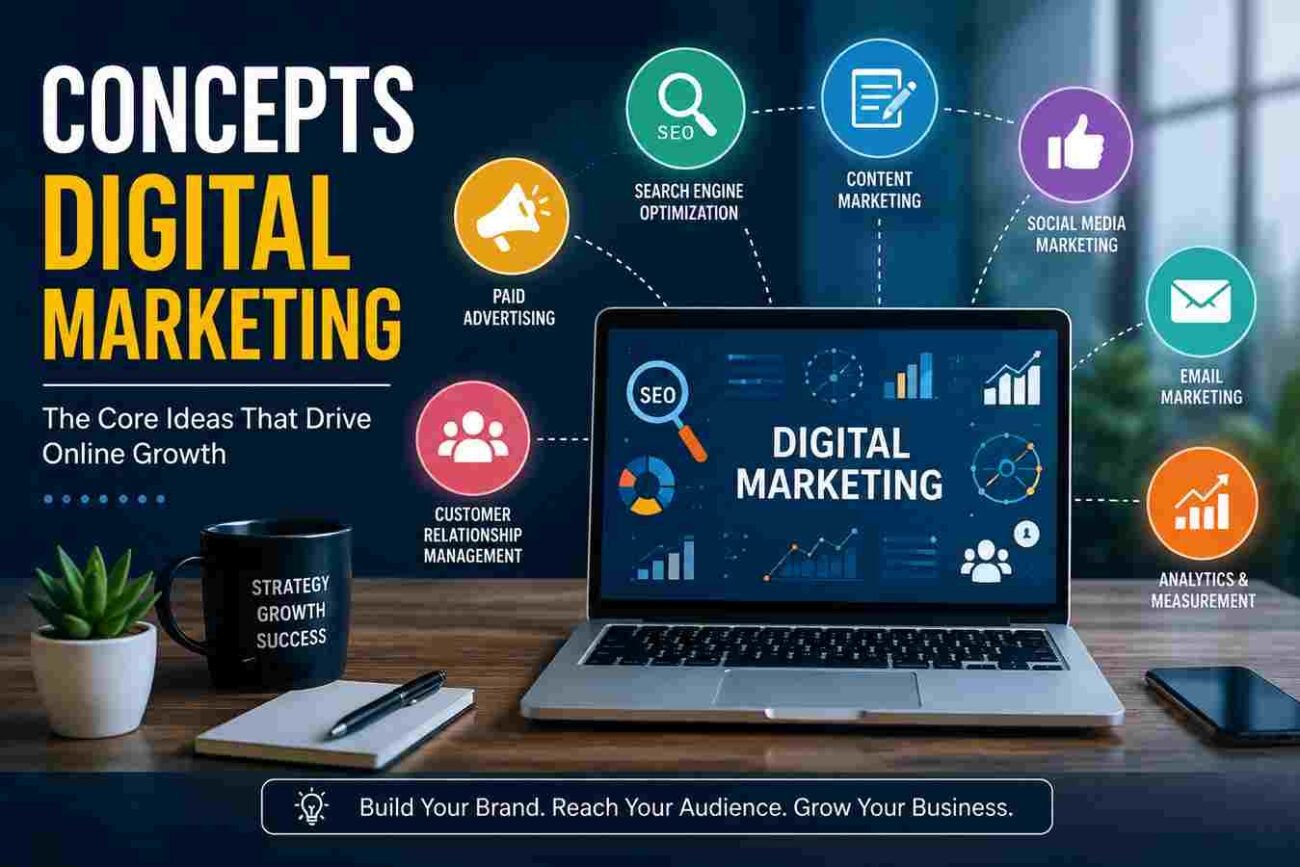
These concepts include search engine optimization (SEO), content marketing, social media marketing, email marketing, paid advertising, conversion optimization, analytics, and customer relationship management. Each strategy serves a different purpose; however, they work best when combined into a clear marketing plan.
For example, a home services company in the United States might use SEO to appear in Google search results. Meanwhile, social media can help build brand awareness, and paid advertising can generate leads more quickly. Finally, email marketing allows the company to stay connected with previous customers.
Therefore, understanding each concept helps businesses choose the right strategies for their goals, audience, and budget.
Search Engine Optimization Is a Fundamental Digital Marketing Concept
Search engine optimization, commonly known as SEO, involves improving a website and its content so that people can discover it through search engines.
SEO is one of the most valuable concepts of digital marketing because potential customers frequently search online for information, products, and services. As a result, a well-optimized website can attract relevant visitors without relying entirely on paid advertisements.
A strong SEO strategy includes:
-
Keyword research and search intent analysis
-
Helpful, original, and relevant content
-
Optimized titles and headings
-
Internal linking between related pages
-
Technical website improvements
-
Mobile-friendly design
-
Fast page loading and a positive user experience
-
Relevant, high-quality backlinks
-
Clear product and service information
However, modern SEO involves much more than repeating keywords throughout an article. Search engines aim to provide useful results that match what people are looking for.
For businesses targeting the U.S. market, understanding search intent is particularly important. For instance, someone searching for a digital marketing agency is probably looking for a service provider. In contrast, a person searching for the meaning of digital marketing may simply want educational information.
Consequently, creating content that matches the user’s needs can improve relevance, attract the right audience, and support long-term organic growth.
Content Marketing Builds Long-Term Visibility
Content marketing is another important concept in digital marketing. It focuses on creating valuable information that helps a specific audience solve problems, answer questions, or make informed decisions.
Businesses can share content through blog posts, videos, guides, case studies, newsletters, infographics, and social media updates. Furthermore, each content format provides an opportunity to communicate with customers in a different way.
For example, a financial services company could publish an article about common budgeting mistakes. Similarly, a software company might create a tutorial explaining how customers can use a particular feature.
The main goal is not simply to publish more pages. Instead, businesses should create content that addresses genuine customer needs and provides practical value.
For U.S. businesses, localized content can also improve relevance. Articles that discuss regional concerns, industry developments, or common questions from American consumers may help attract a more targeted audience.
Ultimately, quality matters more than quantity. Therefore, a consistent content strategy should prioritize accuracy, usefulness, originality, and clear communication.
Social Media Marketing Creates Audience Relationships
Social media marketing involves using platforms such as Facebook, Instagram, LinkedIn, TikTok, and YouTube to communicate with potential and existing customers.
Businesses can use these platforms to increase brand awareness, share educational content, promote products, answer questions, and collect customer feedback. In addition, social media provides opportunities to build communities around a brand.
However, every platform attracts different audiences and supports different marketing goals. For example, a business-to-business technology company may benefit from LinkedIn, whereas a fashion brand might focus on visually engaging platforms such as Instagram and TikTok.
Consistency is equally important. Businesses should maintain a recognizable brand voice, publish useful content regularly, and respond to audience questions. At the same time, they should monitor engagement to understand which topics perform best.
As a result, social media becomes more than an advertising channel. It can help businesses build relationships, strengthen customer trust, and encourage repeat engagement.
Paid Advertising Can Accelerate Customer Acquisition
Organic marketing strategies often require time to produce meaningful results. By comparison, paid digital advertising can help businesses reach potential customers more quickly.
Common advertising methods include paid search campaigns, display ads, social media advertisements, video campaigns, and shopping ads. Moreover, these options allow marketers to target audiences based on factors such as interests, location, search behavior, and previous interactions.
For instance, a local business in Texas can target customers within its service area instead of spending its entire advertising budget on a nationwide audience.
Nevertheless, paid advertising does not guarantee profitable results. Businesses need relevant landing pages, compelling offers, accurate conversion tracking, and continuous campaign testing.
Therefore, the main objective should be profitable customer acquisition rather than simply generating clicks or impressions.
By reviewing campaign performance regularly, marketers can identify which advertisements work best and allocate their budgets more effectively.
Email Marketing Supports Customer Retention
Email marketing remains an important part of digital marketing because it gives businesses a direct way to communicate with people who have chosen to receive their messages.
Companies can send newsletters, product announcements, educational resources, promotional offers, welcome messages, and customer retention emails. In addition, automated email sequences can help businesses maintain communication without manually sending every message.
However, effective email marketing depends on relevance. Sending the same message to every subscriber may not produce the best results.
Instead, segmentation allows marketers to group subscribers according to their interests, behavior, purchase history, or relationship with the business. For example, new subscribers might receive introductory emails, while existing customers could receive personalized recommendations or loyalty offers.
As a result, subscribers receive more relevant information, which can improve engagement and strengthen customer relationships.
Most importantly, businesses should provide genuine value and respect subscriber preferences when planning their email campaigns.
Analytics and Conversion Optimization Turn Data Into Decisions
One of the biggest advantages of digital marketing is its ability to measure performance. Through analytics tools, businesses can evaluate website traffic, engagement, leads, conversion rates, advertising costs, and sales.
This information helps marketers answer important questions. Which channels attract the most valuable customers? Which pages generate the most leads? Where do visitors leave the website? Furthermore, which campaigns provide a positive return on investment?
Conversion rate optimization (CRO) focuses on increasing the percentage of visitors who complete a desired action. Depending on the business, that action might involve purchasing a product, submitting a contact form, booking an appointment, or subscribing to a newsletter.
For example, improving a headline, simplifying a form, or making a call to action more visible may encourage more visitors to take the next step.
However, businesses should avoid making decisions based only on assumptions. Instead, they can analyze user behavior and test different approaches to identify what works best.
Consequently, analytics and conversion optimization help companies make informed decisions, improve marketing efficiency, and use their resources more effectively.
Local and Customer-Centric Digital Marketing Matters
For many American businesses, online visibility depends on reaching customers in specific cities or regions. Restaurants, healthcare practices, contractors, retailers, and other service providers often need to attract people within their local markets.
Local digital marketing can include optimized location pages, accurate business information, customer reviews, useful local content, and a well-maintained Google Business Profile when eligible.
Nevertheless, local visibility alone is not enough. Businesses must also understand the needs, preferences, and concerns of their target customers.
Customer personas can help marketers identify common problems, motivations, buying behaviors, and objections. Furthermore, customer feedback can reveal opportunities to improve products, services, and website content.
When businesses answer real customer questions, their content becomes more useful and relevant. As a result, they can build stronger relationships and attract visitors who are more likely to become customers.
How Do the Concepts of Digital Marketing Work Together?
Digital marketing is most effective when its different strategies support one another. Rather than treating each channel separately, businesses should create an integrated plan that guides customers through the buying journey.
For example, SEO can attract organic visitors, while content marketing provides the information those visitors need. Meanwhile, social media expands content distribution, and paid advertising helps reach new audiences. Email marketing can then nurture leads, while analytics measures the results.
Consider a U.S. e-commerce business launching a new product. First, the company could publish an informative product guide and optimize it for relevant search terms. Next, it could share the guide on social media and run targeted advertising campaigns.
Additionally, the business could encourage interested visitors to subscribe to its email list. Finally, analytics would help the company determine which channels generate the most valuable traffic and sales.
This connected approach helps businesses understand their customers and avoid depending entirely on one traffic source. Therefore, combining the right digital marketing concepts can support more consistent and sustainable growth.
Frequently Asked Questions About Digital Marketing Concepts
What Are the Five Major Concepts of Digital Marketing?
Five major concepts include SEO, content marketing, social media marketing, paid advertising, and email marketing. However, analytics and conversion optimization are also important because they help businesses measure performance and improve their strategies.
Why Are Digital Marketing Concepts Important?
Digital marketing concepts help businesses understand how customers discover brands, evaluate products, and make purchasing decisions. Consequently, businesses can develop more focused strategies, reach relevant audiences, and measure their results.
Which Digital Marketing Concept Is Best for Beginners?
SEO and content marketing are useful starting points for many beginners because they teach essential skills such as keyword research, audience analysis, website optimization, and content creation. Additionally, these skills can support long-term online visibility.
How Can a Small U.S. Business Use Digital Marketing?
A small business can begin with a professional website, local SEO, useful content, social media, customer reviews, and email marketing. If the budget allows, carefully measured paid advertising can also help generate leads. Most importantly, the strategy should focus on the right customers and locations.
Is Digital Marketing Better Than Traditional Marketing?
Neither approach is automatically better for every business. Digital marketing offers detailed targeting and measurable performance, whereas traditional marketing can still reach valuable audiences through channels such as print, radio, and television. Therefore, some businesses benefit from combining both approaches.
Conclusion
Understanding the concepts of digital marketing is an important step toward building a successful online strategy. SEO helps customers discover businesses, content marketing provides valuable information, and social media encourages engagement. Meanwhile, paid advertising can expand reach, email marketing supports customer retention, and analytics helps measure results.
Ultimately, sustainable digital marketing requires more than quick fixes or repeated promotional messages. Businesses need to understand their audiences, create helpful content, maintain a positive online experience, and improve their strategies over time.
For companies competing in the U.S. market, combining customer-focused communication with technical quality, relevant content, and measurable business goals can create a stronger foundation for long-term online growth.

2 thoughts on “Best Concepts of Digital Marketing: A Complete Guide to Online Growth”