
Technology is no longer limited to computers and smartphones. It is part of almost every area of modern life from healthcare and education to transportation communication business and energy. As new innovations continue to develop understanding the major categories of technology can help people recognize how digital and scientific tools are changing the world.
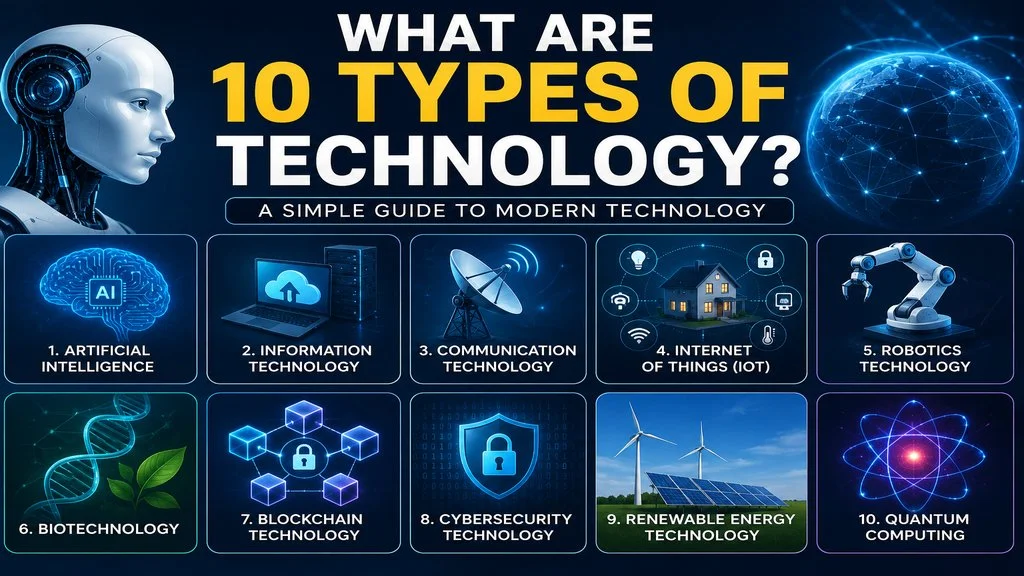
So what are 10 types of technology? The answer can vary depending on how technology is classified but ten major categories include Artificial Intelligence Information Technology Communication Technology Internet of Things Robotics Biotechnology Blockchain Cybersecurity Renewable Energy Technology and Quantum Computing. These fields often overlap with one technology supporting or improving another.
In this guide we will explain each type in simple terms provide practical examples and explore why these technologies matter for individuals and businesses in the United States.
What Are 10 Types of Technology?
There are many ways to classify technology but the following ten categories represent important areas of modern innovation:
- Artificial Intelligence
- Information Technology
- Communication Technology
- Internet of Things
- Robotics Technology
- Biotechnology
- Blockchain Technology
- Cybersecurity Technology
- Renewable Energy Technology
- Quantum Computing
These technologies are not isolated. For example a smart factory may use AI IoT sensors robotics cloud computing and cybersecurity at the same time.
1. Artificial Intelligence
Artificial Intelligence (AI) is technology that enables computer systems to perform tasks that normally require human intelligence. These tasks can include recognizing patterns understanding language analyzing information making predictions and generating content.
AI is already being used in customer service healthcare finance transportation marketing and software development.
For example businesses can use AI-powered systems to analyze customer questions automate repetitive work identify trends in large datasets and provide personalized recommendations.
Generative AI has also made artificial intelligence more accessible to everyday users. Instead of simply following fixed instructions modern AI systems can work with natural language and help people create text images code and other digital content.
2. Information Technology
Information Technology (IT) focuses on using computers software networks servers databases and digital systems to create process store and manage information.
Almost every modern organization depends on IT. A small business may use computers cloud storage accounting software email and online collaboration platforms while a large corporation may operate complex networks and enterprise systems.
Cloud computing is an important part of modern IT because organizations can access computing resources and storage without maintaining all the necessary hardware themselves.
IT also provides the foundation for many other technologies including AI cybersecurity data analytics and digital business platforms.
3. Communication Technology
Communication technology allows people and organizations to exchange information electronically across distances.
Examples include smartphones wireless networks fiber-optic connections satellites Wi-Fi Bluetooth and cellular networks.
In the United States communication technology supports remote work video meetings online education digital entertainment e-commerce and connected services.
Modern communication systems are also becoming increasingly important for businesses because customers expect fast and convenient digital communication.
4. Internet of Things (IoT)
The Internet of Things (IoT) refers to physical devices that connect to networks and exchange data.
Smart thermostats connected security cameras wearable devices smart appliances industrial sensors and connected vehicles are examples of IoT technology.
IoT can help organizations monitor equipment and collect information in real time. For instance a factory can use sensors to identify unusual machine behavior before equipment completely fails.
In homes IoT can improve convenience by allowing people to control lighting temperature security and other devices through connected systems.
5. Robotics Technology
Robotics technology combines machines sensors software control systems and increasingly AI to perform physical tasks.
Robots are widely used in manufacturing warehouses healthcare agriculture research and other industries.
Industrial robots can perform repetitive tasks such as assembly welding packaging and material handling. Other robots are designed for specialized environments where human workers may face safety or efficiency challenges.
The combination of robotics and AI is particularly important because robots can become better at responding to changing environments rather than simply repeating one programmed movement.
6. Biotechnology
Biotechnology applies biological knowledge and processes to create useful products treatments and solutions.
It has applications in medicine agriculture food production environmental science and pharmaceutical research.
Examples include genetic engineering gene-editing techniques vaccines biologic medicines improved crops and biological manufacturing processes.
Biotechnology is especially important because it connects technology with living systems. Advances in this field may help researchers address challenges involving healthcare food production and environmental sustainability.
7. Blockchain Technology
Blockchain is a digital record-keeping technology designed to store information across a distributed network.
Although blockchain became widely known because of cryptocurrencies its potential uses extend beyond digital currencies.
Organizations can explore blockchain for areas such as supply-chain tracking digital identity transaction records smart contracts and verification systems.
One of its major characteristics is that records can be designed to provide transparency and resistance to unauthorized changes although the security and usefulness of any blockchain system depend on how it is designed and implemented.
8. Cybersecurity Technology
As more personal financial and business information moves online cybersecurity has become an essential area of technology.
Cybersecurity includes tools practices and systems designed to protect computers networks applications accounts and data from unauthorized access and cyber threats.
Common security measures include encryption firewalls multi-factor authentication endpoint protection monitoring and access controls.
For American businesses strong cybersecurity is particularly important because a security incident can affect operations customer trust finances and sensitive information.
Cybersecurity is therefore not simply an IT concern; it is an important part of responsible digital business.
9. Renewable Energy Technology
Renewable energy technology focuses on producing energy from naturally replenished sources such as sunlight wind and water.
Solar panels wind turbines battery-storage systems and modern energy-management technologies are examples.
Renewable energy technology can help reduce dependence on fossil fuels while supporting the development of more sustainable energy systems.
Technology is also improving how renewable energy is stored distributed monitored and integrated into larger electricity networks.
As energy demand grows alongside data centers electric vehicles and digital infrastructure efficient energy technologies are becoming increasingly important.
10. Quantum Computing
Quantum computing is an advanced approach to computing that uses principles of quantum mechanics to process information in fundamentally different ways from conventional computers.
Quantum computers are still an emerging technology and are not expected to replace ordinary computers for everyday tasks. Instead researchers are exploring their potential for highly specialized problems.
Possible applications include scientific research optimization materials discovery chemistry and cryptography.
Although practical quantum computing is still developing it is considered an important area of future technology because sufficiently capable quantum systems could solve certain problems that are extremely difficult for classical computers.
Why Are These 10 Types of Technology Important?
These technologies matter because they are increasingly connected.
For example a modern business might use AI to analyze information cloud computing to run applications IoT sensors to collect data robotics to automate physical work and cybersecurity to protect everything.
This combination creates a larger technology ecosystem rather than ten completely separate categories.
For individuals understanding these areas can also make it easier to identify useful digital skills. Someone interested in programming might explore AI or IT while another person interested in science could consider biotechnology or renewable energy.
Which Type of Technology Is Growing the Fastest?
There is no single technology that is guaranteed to grow faster than every other field. However AI robotics IoT cybersecurity renewable energy and quantum computing are among the areas receiving significant attention and investment.
AI is particularly influential because it can be integrated into many other technologies. Current technology trends are increasingly focused on combining AI with connected devices automation data systems and business processes.
Frequently Asked Questions
What are 10 types of technology?
Ten major types of technology are Artificial Intelligence Information Technology Communication Technology Internet of Things Robotics Biotechnology Blockchain Cybersecurity Renewable Energy Technology and Quantum Computing.
What is the most common type of technology?
Information technology is one of the broadest and most widely used categories because computers software networks databases and digital services support modern businesses and everyday activities.
How does technology affect everyday life?
Technology helps people communicate work learn shop travel manage finances access entertainment and obtain services. Many everyday activities now depend on interconnected digital systems.
Which technology should beginners learn?
The best choice depends on a person’s goals. Beginners interested in business may start with basic IT data analytics or AI tools while aspiring developers may focus on programming and computer science fundamentals.
What will technology look like in the future?
Future technology will likely become more interconnected. AI robotics IoT biotechnology renewable energy and advanced computing may increasingly work together to solve complex problems and create new products and services.
Conclusion
So what are 10 types of technology? The answer includes Artificial Intelligence Information Technology Communication Technology IoT Robotics Biotechnology Blockchain Cybersecurity Renewable Energy Technology and Quantum Computing.
Each category has a different purpose but together they are helping shape the modern digital economy. From AI-powered software and smart devices to renewable energy systems and emerging quantum computers technology continues to influence how people live and how businesses operate.
For anyone trying to understand the technology landscape in 2026 learning the basics of these ten categories is a useful starting point. The most important thing is not simply knowing technology names but understanding what each technology does where it is used and how different technologies work together.

One thought on “What Are 10 Types of Technology? A Simple Guide to Modern Tech”